
Guides
Bookkeeping Firm Marketing: Services, Referrals and Reviews
Bookkeeping firm marketing in practice: how clear service pages, referral handoffs, honest review requests, and close capacity shape client acquisition.
What to take away
- Bookkeeping firm marketing starts with a promise narrow enough to name the ledger work, systems and close calendar, rather than "stress-free books".
- Publish the service menu with the monthly close, cleanup, payroll support and reporting cadence written out, so a prospect can check fit before the first call.
- Cap new engagements by reviewer hours and close slots, not by how many calls the pipeline books.
- Move client files to a CPA, enrolled agent or lender only after written consent, and keep the consent record.
- Ask for reviews after a defined milestone, never gate them, never pay for them, and never disclose client finances in a reply.
This article covers firm operations and marketing. It is not tax, legal, payroll or accounting advice for any client engagement. Licensing, CPA supervision, filing rules and client duties vary by state and country, so confirm current requirements with your state board of accountancy, the IRS and FinCEN before you act.
A promise narrow enough to sell
"Stress-free books" sells nothing, because no owner can check it. Name the ledger work instead: catch-up cleanup on two years of commingled funds, or a monthly close for a restaurant group running three POS systems into one clearing account.
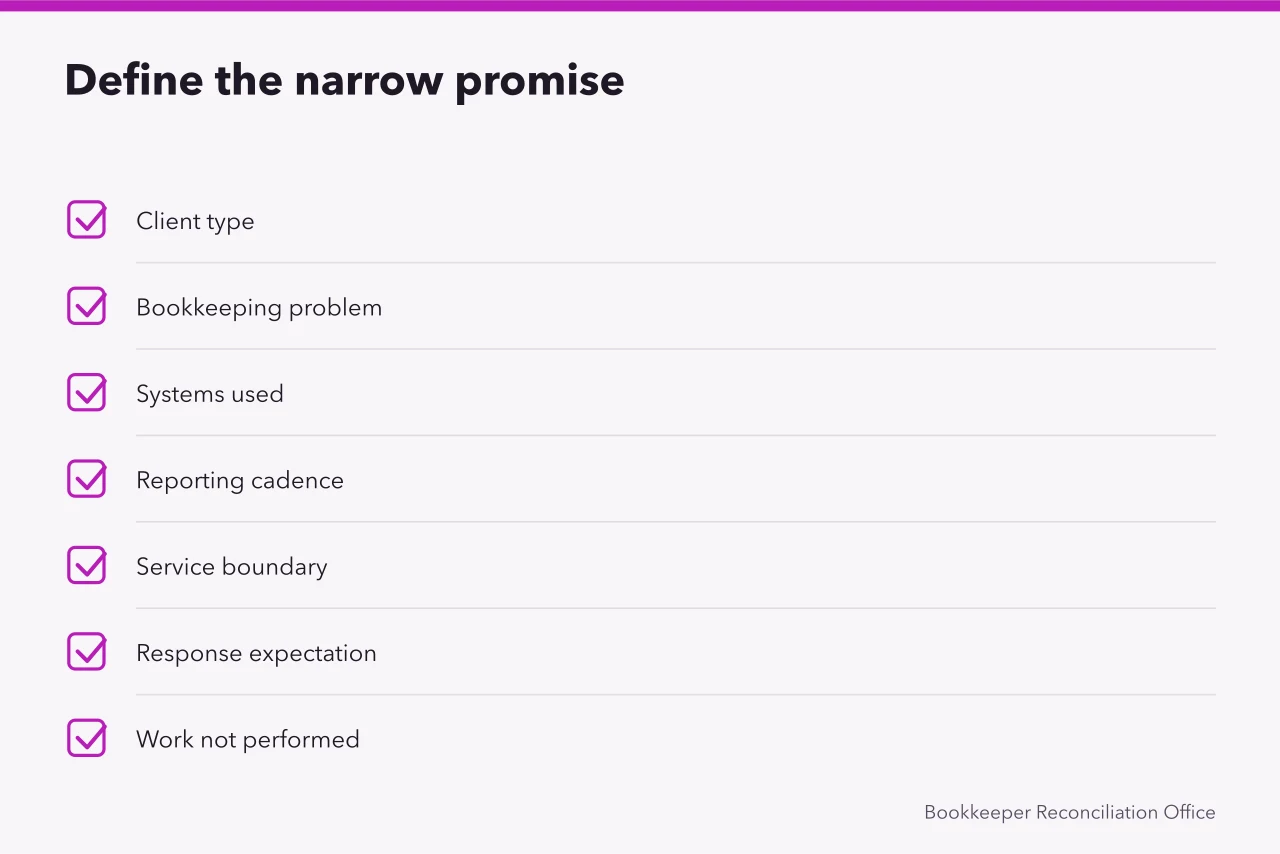
Write the promise as a sentence a prospect can test against their own books. It carries the client type, the systems, the reporting date and the work the firm declines.
The decline list does the heavy lifting. A firm that states it does not prepare returns, does not sign payroll filings and does not hold client funds removes the three conversations that waste the most discovery time.
That narrowness is also the first step toward winning more bookkeeping firm clients, because it tells the right owner to call and the wrong one to keep looking.
Test the promise end to end
- Discovery
- Proposal
- Engagement
- Secure access
- Transaction processing
- Reconciliation
- Month-end review
- Reporting
Test it in a normal week and again in a bad one. A close that runs clean in February can fall apart in April, when payroll deadlines, estimated payments and client questions land together.
Give one person authority to maintain the promise and to flag every exception in writing. Exceptions are where the promise is quietly widening.
Service pages that answer the close
A service page should let a prospect picture their own month. Say when the bank feed is reviewed, when the reconciliation is tied out, and which day the reports land.
List the items the engagement covers, and the ones it does not:
- Monthly bank and credit-card reconciliation
- Undeposited funds and clearing-account cleanup
- Payroll support, with the filing responsibility named
- Payables and receivables, including who approves a bill
- Month-end reports and the review call
- Sales tax filings, or a written statement that the firm does not file them
State the client's own duties on the same page. Late receipts, unreviewed expense reports and unanswered questions all move the close date, and saying so up front prevents the argument later.
Detail what changes for each role: the bookkeeper who codes transactions, the reviewer who ties out the reconciliation, the payroll specialist, and the client's own approver. What each page should contain is set out in the bookkeeping firm service menu.
Resist building a near-duplicate page for every city and industry. Ten thin pages rank worse than one page that answers the close.
Channels and content that point to the service page
Use channels that send prospects to a clear service page, rather than publishing generic bookkeeping tips. For local intent, maintain a complete Google Business Profile and connect it to relevant service pages; support it with local SEO. LinkedIn can help a firm explain its niche and build relationships with local professionals, while an email newsletter can keep existing contacts informed.
Give prospects something concrete to evaluate: a short case study published with client permission, a downloadable close-readiness checklist, or a webinar about preparing records for month-end. Keep each piece consistent with the services the firm actually offers and link it back to the relevant service page.
Record lead sources in a CRM such as HubSpot, or in a spreadsheet. Calendly can handle scheduling and DocuSign can handle engagement-letter signatures; keep the service scope and client approval process clear regardless of the tools used.
Credentials, claims and the evidence behind them
Keep every title, certification and software partnership current and supportable. "QuickBooks Online ProAdvisor" means something only while the certification is live.
The same applies to experience claims and client counts. A claim you cannot produce a record for is a claim you should delete.
Run a limited pilot before you publish a new claim. Write the expected result and the earliest sign it is failing, then compare the claim against current evidence and decide to expand, revise or stop.
Calling work audited, certified or guaranteed without a basis is the mistake that draws complaints. Assurance work in particular belongs to a licensed CPA, not to a bookkeeping engagement.
Referral routes to CPAs and enrolled agents
Referrals from CPAs, enrolled agents, attorneys, lenders and fractional CFOs arrive pre-qualified, because someone who knows the client's situation already decided the firm fits.
Build the handoff before you need it. Agree who sends the trial balance, in what format, on which date, and who answers the client's questions in between.
Consent before a file moves is a legal duty, not a courtesy. Get it in writing, name the recipient, and keep the record with the engagement file.
Never imply that a CPA, an enrolled agent or a lender endorses the firm. A referral is a working relationship, and describing it as an endorsement misstates it.
Review completed referrals by source on a regular schedule. A source that sends good clients twice a year is worth more than one that sends volume that never closes.
Track introductions in a CRM or spreadsheet with the referrer, date, client consent, stage and outcome. This makes it possible to compare qualified inquiries and signed engagements by source instead of judging a referral relationship by anecdotes.
Put the handoff in writing: say who obtains client consent, what information may be shared, who follows up, how the relationship will be described, and whether either party expects a fee or reciprocal introductions. If compensation is contemplated, check applicable professional and state rules before agreeing to it. A simple consent request might read: “May I share [records] with [recipient] for [purpose]?” Name the recipient and purpose before sending anything.
Reviews, requests and the FTC rules
The Federal Trade Commission: Advertising FAQs: A Guide for Small Business requires advertising claims to be truthful and supported, and endorsements to reflect honest experience with material relationships disclosed.
Marketing compliance rules
- Advertising claims truthful and supported
- Endorsements reflect honest experience
- Disclose material relationships
- Request reviews from genuine users
- No incentives creating false picture
- Complete business information and hours
- Protect customer privacy
The U.S. Federal Trade Commission: Soliciting and Paying for Online Reviews: A Guide for Marketers says requests should go to genuine clients, not only the ones likely to praise you.
Do not gate a request behind a satisfaction survey, and do not offer a discount for a review. Either practice distorts the picture a prospect uses to judge the firm.
Ask after a defined milestone, such as the third monthly close. That is late enough for the client to know how the work feels and early enough that they remember onboarding.
Choose review destinations prospects actually use, such as Google Business Profile, Yelp or Clutch, and keep the firm’s profile details consistent. Track requests sent, reviews received, qualified inquiries that mention a review, and the lead source; compare the request-to-review rate alongside inquiry flow to see whether requests are producing useful visibility.
When you reply, never disclose client finances, tax details, software, disputes or identity. "Thank you, we are glad the close is running on schedule" says enough.
Reviews mostly report what delivery felt like, which is the subject of bookkeeping firm service quality. A review cannot tell a prospect whether the reconciliation was tied out.
Capacity: the limit on every campaign
Onboarding slots, reviewer hours and software competence cap growth. So do payroll deadlines and the close calendar.
Count the hours a new monthly client actually consumes: transaction coding, reconciliation, the review pass, the reporting call and the email trail. Multiply by the number of clients you can carry before the close slips.
That arithmetic, not the pipeline, sets the campaign size. Signing more monthly clients than the team can reconcile and review shows up as late closes, and late closes are how firms lose the clients they just won.
Review sales backlog against on-time first closes every month. If first closes slip, check demand, capacity, training, pricing and data quality before you change the standard.
The software and measurement side of that is worked out in the guide to bookkeeping firm software.
Thirty days to a running process
- Week 1list the firm’s current marketing channels, lead sources, service-page gaps, referral routes and review profiles; name an owner for each.
- Week 2choose one channel to improve, update the relevant service page, and prepare a case study, checklist, newsletter item or webinar that accurately reflects the firm’s work.
- Week 3publish the update, test the referral-tracking and consent process, and make a neutral review request to eligible clients at a defined milestone.
- Week 4compare qualified inquiries, proposal acceptance, onboarding capacity, on-time first closes and lead sources; record what worked and decide whether to expand, revise or stop.
Thirty days to running
- Week 1Document process, owners, data sources, failure point
- Week 2Test one measurable change, collect worker comments
- Week 3Correct workflow, update standard, train roles
- Week 4Compare results, record risks, set review date
Put an effective date on the standard, name the approved version, and keep superseded copies out of daily use. Staff need to know where the current process lives and how to report a conflict between the written rule and the real work.
Common questions
Who should own the marketing process?
The firm owner sponsors it, but daily ownership belongs to whoever controls the close calendar and the client list. Compliance questions go to the CPA or attorney who handles them, not to the marketing owner.
How often should a firm review its numbers?
Monthly while the process is new, then on a stable schedule once the data is reliable. Reopen the decision when services, staffing, software, ownership or regulation changes.
Which numbers matter most?
Use the smallest set that can change an action: qualified inquiries, proposal acceptance, onboarding slots filled, on-time first closes, and gross margin per client. Write the formula and the data source before comparing periods.
What should a firm avoid when it copies a competitor?
Avoid copying another firm's price, software stack, service menu or staffing ratio without knowing its client mix and constraints. A general article cannot replace advice on your own jurisdiction, entity or engagement.
Before you publish, have the operations lead, the reviewer who ties out reconciliations and one client-facing bookkeeper read the section they work in. Their questions expose missing handoffs, undefined terms and measures the system cannot produce.