
Guides
Winning bookkeeping firm clients without a price war
'bookkeeping firm customer acquisition' connects customer access, operating capacity, staffing, and cash. This guide treats the topic as a series of decisions that.
What to take away
- Win on scope, not rate. Quote a named outcome such as a ten-day close for Shopify and Amazon sellers, not a bare hourly fee.
- Price the outcome and the records you receive. Charge onboarding and cleanup on their own lines so the monthly fee holds.
- Publish one page per package, each answering one narrow question.
- Ask every client for a review at the same milestone, after the third close.
- Track cost per qualified conversation and contribution margin by source.
Sell the outcome, not the hour
A price war starts when two firms quote the same hourly rate for the same generic work. The only question left is who is cheaper.
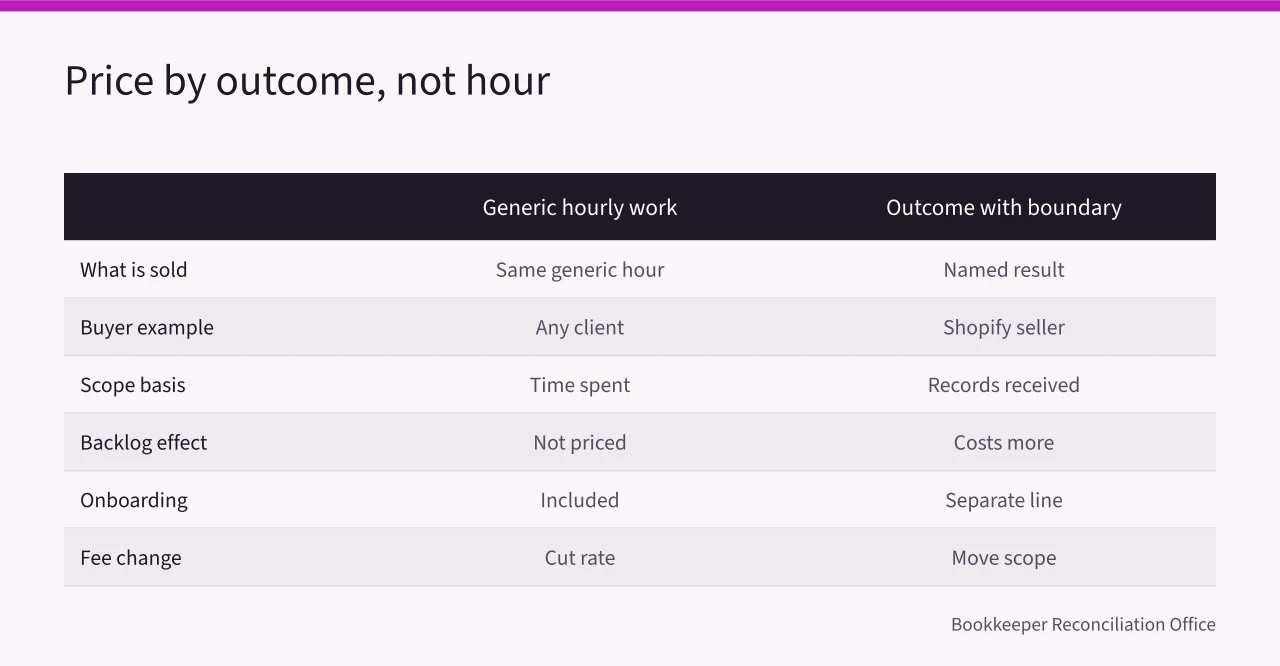
Sell a result with a boundary. A seller on Shopify and Amazon wants settled payouts and a close they can read in ten minutes. A nonprofit board wants three years of catch-up cleanup before an audit. A restaurant owner wants biweekly payroll filed and tips reconciled.
The customer acquisition and growth guide follows a prospect from first inquiry to retained client, stage by stage.
Name the tools the client already runs, because scopes are written against them. Ledger work happens in QuickBooks Online, Xero, or Wave. Payables often run through Bill.com or Ramp. Revenue arrives via Stripe or Square, and Shopify sellers add settlement matching.
Restaurant payroll support means reconciling liabilities against deposits. The IRS explains the employment tax deposits and reporting cycle the client pays you to keep clean.
Price by outcome and by the records you receive. Three years of backlog with missing receipts costs more than a clean monthly close. Onboarding is a separate line when the chart of accounts needs repair.
If the fee has to move, move the scope with it. A lower price for identical work tells the client the work was never worth the fee.
What changes in 2027
Since 2024 the main search engines place a generated summary above the usual links. A page that merely states the firm does bookkeeping is invisible there. A page that answers one narrow question, with a platform name and a date, can be quoted inside that summary.
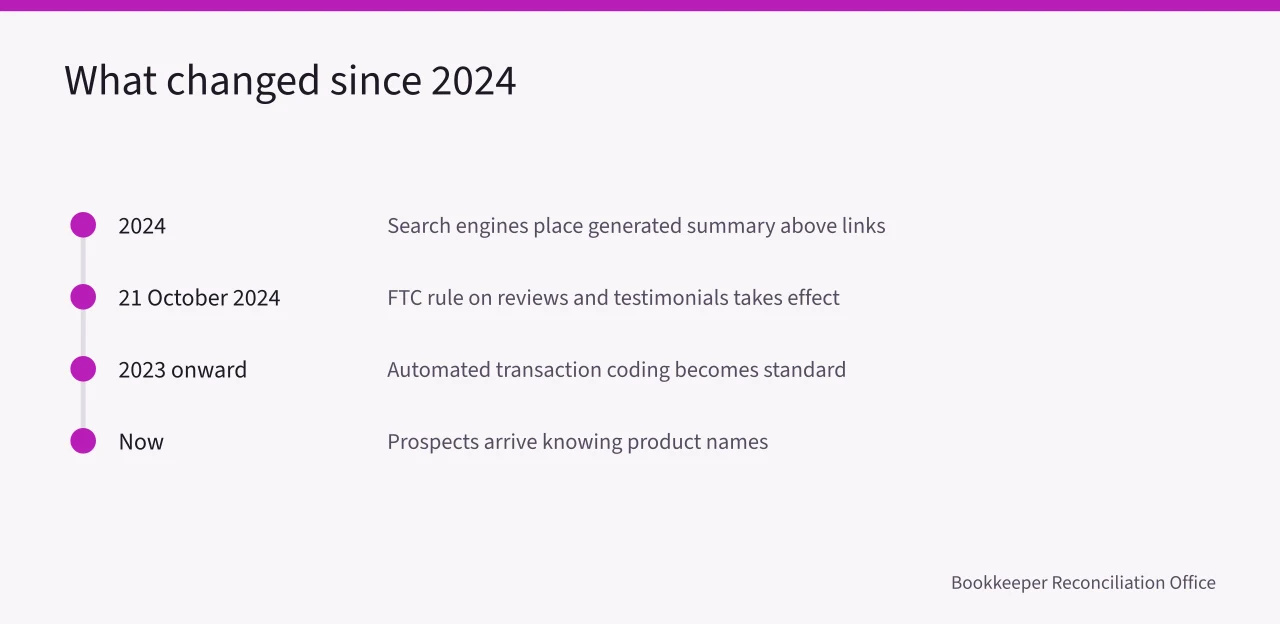
The FTC rule on consumer reviews and testimonials took effect on 21 October 2024. Buying reviews, or paying only for praise, now carries penalty exposure. The rules on soliciting and paying for online reviews shape how a firm asks.
Automated transaction coding is now standard inside the main ledger platforms. Routine coding takes fewer hours than it did in 2023, which makes a fixed cleanup fee safer to quote.
Prospects arrive knowing product names. They searched for Shopify payout matching, or for Gusto reporting, before they found you.
Example: one page, one promise
Here is a page aimed at one buyer, with a headline a firm could publish this quarter.
Headline: Bookkeeping for Shopify and Amazon sellers: a ten-day month-end close, priced per store.
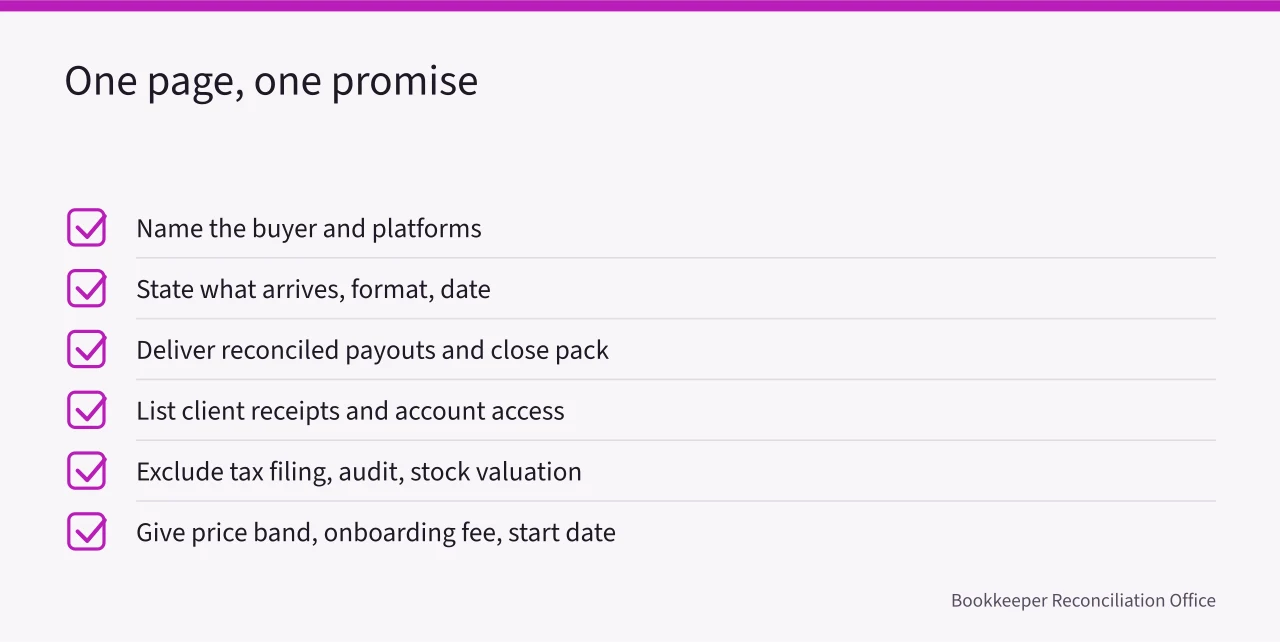
One page, one promise
- One sentence naming the buyer and the platforms involved.
- What arrives each month, in what format, and by which date.
- What you deliver, including reconciled payouts and a close pack.
- What you need from the client, including receipts and account access.
- What is excluded, such as tax filing, audit support, and stock valuation.
- A price band, the onboarding fee, and the next start date.
Any claim about results on that page is advertising. The FTC advertising FAQs require such claims to be truthful and supported.
One page per package beats fifty near-duplicate city pages. The bookkeeping firm service menu lists the packages worth publishing before you write a headline.
Ask every client at the same milestone
Pick a milestone and hold it. The third monthly close works well, because the client has watched the work land twice and the outcome is still fresh.
Ask everyone, not only the clients you expect to praise you. Skip discounts, gift cards, and any filter that hides an unhappy account.
Sixty active clients asked twice a year is about 120 requests. A 20 to 30 percent response rate is a workable planning range, which yields 24 to 36 new reviews a year.
Channel arithmetic you can measure
The ranges below are planning placeholders, not measured benchmarks.
| Channel | Planning range, inquiry to signed client | What decides it |
|---|---|---|
| Client referrals | 1 in 3 to 1 in 2 | Asking at the third close, not at signing |
| CPA or tax preparer referrals | 1 in 2 to 2 in 3 | Depth of one partner relationship |
| Google Business Profile and local search | 1 in 8 to 1 in 5 | Review volume and a complete profile |
| Paid search | 1 in 20 to 1 in 10 | Click cost against first-month margin |
| Cold lists and bought leads | Under 1 in 50 | Usually filtered or already shopped |
Contribution margin per client tells you whether a channel is worth repeating. The ranking of profitable bookkeeping firm services shows which work produces that margin.